Test Simple 3-level Multivariate Normal Model
John Flournoy
2020-04-01
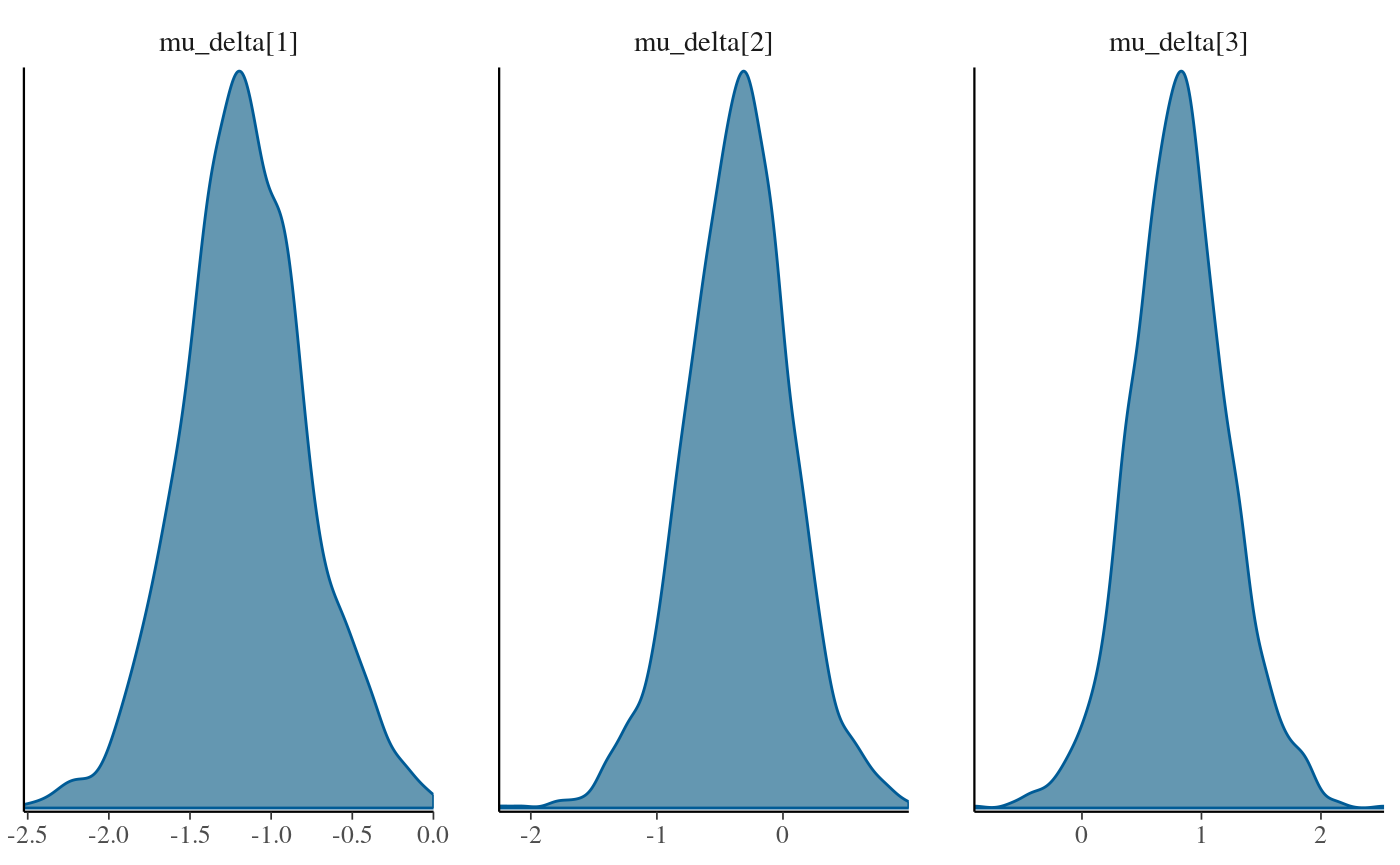
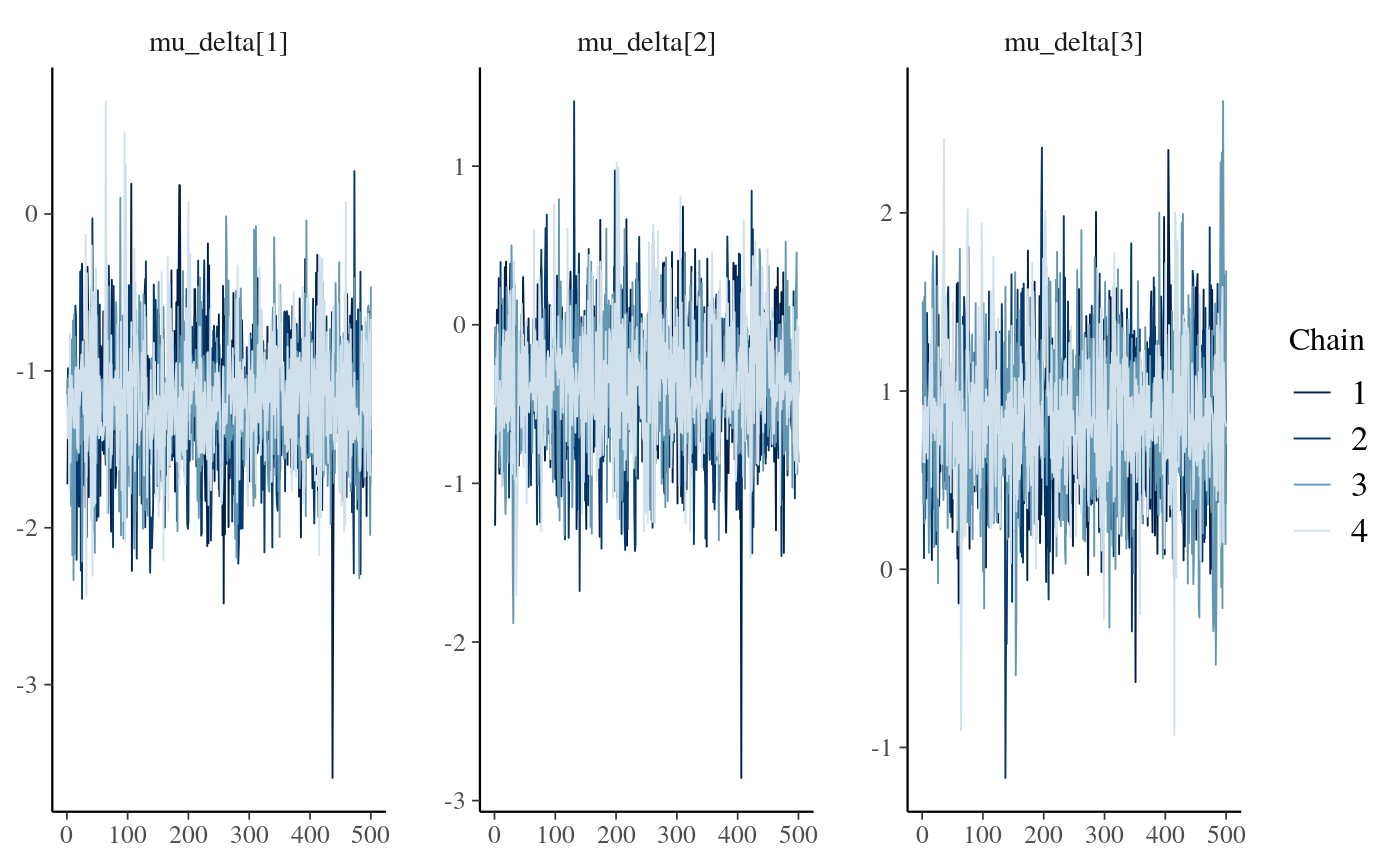
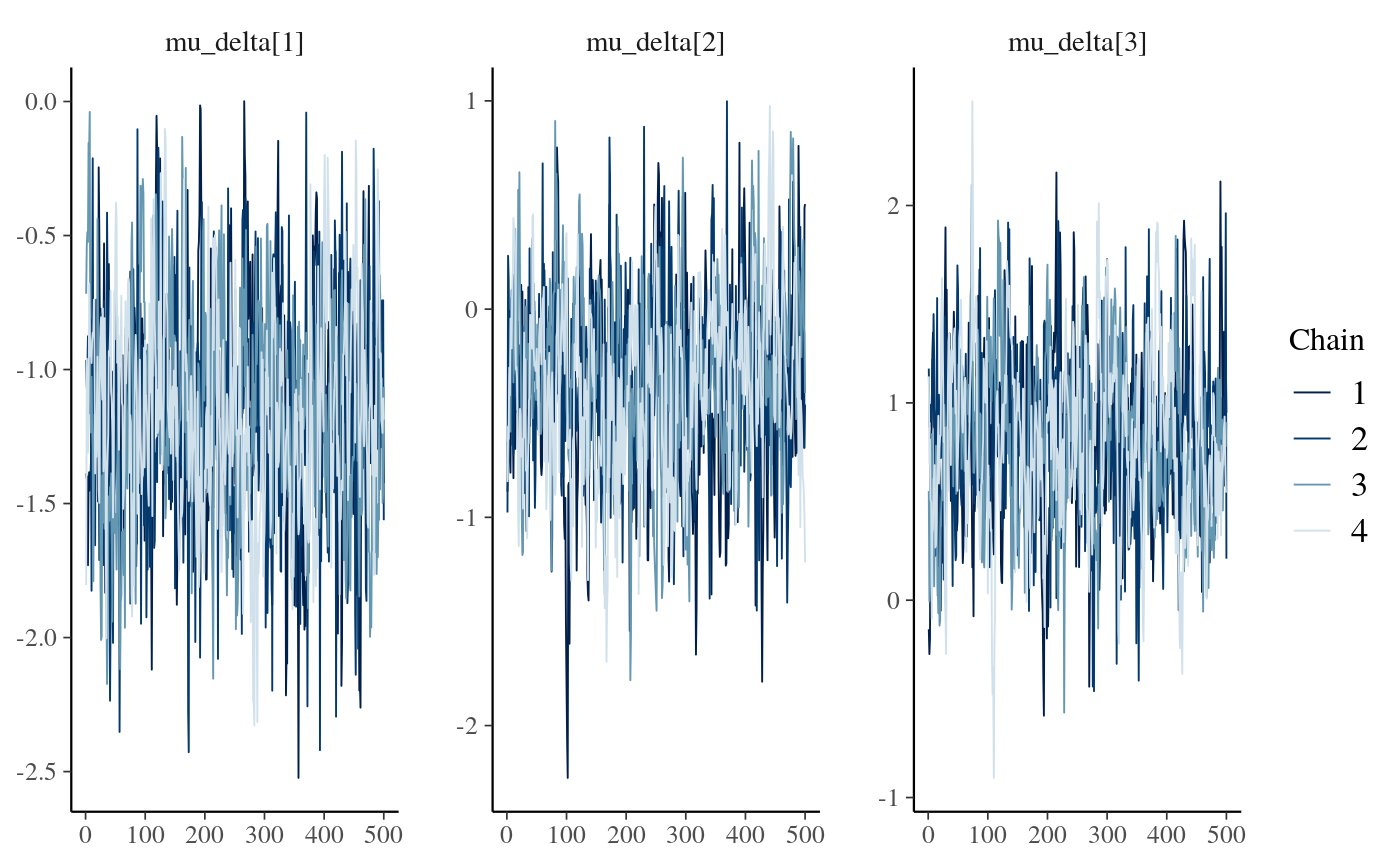
test-simple-3l-mv-model.RmdThe goal of this vignette is to demonstrate that the multivariate normal model that I will use for each parameter in the learning model is able to be estimated accurately and without prohibitively excessive computer time. In these examples I show that accounting for the nested structure of data with observations nested in participants nested in sample may be important. I also show that the 3-level model using both centered and non-centered parameterization of the 3rd level group means gives similar results. Finally, it may be helpful to note that the centered (that is, standard) parameterization finishes sampling in much less time than the non-centered model.
Generate data where there are 3 conditions, and individual variation in probability of choosing ‘left’ for each condition. Set the mean probability of left for each condition to values in beta_mu below.
library(probly)
set.seed(150319/2018)
j <- 300 #number of subjects
t <- 100 #number of trials
g <- 4 #number of subsamples
c <- 3 #number of conditions
n <- t*c*j #number of observations
gg <- sample(1:g, size = j, replace = T) #group IDs

hyper_gamma_mu <- c(-1, 0, 1) #The mean population effect
hyper_gamma_sigma <- 1
gamma_mu <- matrix(rnorm(c*g, hyper_gamma_mu, hyper_gamma_sigma), nrow = g, byrow = T) #specific sample mean effects
gamma_sigma <- matrix(
    c(1, .2, .2,
      .2, 1, .2,
      .2, .2, 1),
    nrow = 3, byrow = T
) #correlation among random effects at between individuals in the same sample

beta_j <- t(apply(gamma_mu[gg,], 1, function(mu) {MASS::mvrnorm(1, mu, gamma_sigma)}))

beta_j_df <- as.data.frame(beta_j)
beta_j_df$b0 <- beta_j_df[,1]
beta_j_df$b1 <- beta_j_df[,2] - beta_j_df[,1]
beta_j_df$b2 <- beta_j_df[,3] - beta_j_df[,1]

summary(beta_j_df)
#>        V1                V2                V3                b0
#>  Min.   :-4.0175   Min.   :-4.2855   Min.   :-2.4245   Min.   :-4.0175
#>  1st Qu.:-1.9721   1st Qu.:-1.2661   1st Qu.: 0.0265   1st Qu.:-1.9721
#>  Median :-1.2353   Median :-0.4610   Median : 0.8560   Median :-1.2353
#>  Mean   :-1.2108   Mean   :-0.3778   Mean   : 0.8281   Mean   :-1.2108
#>  3rd Qu.:-0.5176   3rd Qu.: 0.5260   3rd Qu.: 1.6584   3rd Qu.:-0.5176
#>  Max.   : 2.5766   Max.   : 3.1939   Max.   : 3.5379   Max.   : 2.5766
#>        b1                b2
#>  Min.   :-3.1894   Min.   :-2.186
#>  1st Qu.:-0.3325   1st Qu.: 1.077
#>  Median : 0.7406   Median : 2.104
#>  Mean   : 0.8330   Mean   : 2.039
#>  3rd Qu.: 1.9007   3rd Qu.: 3.065
#>  Max.   : 5.5439   Max.   : 5.840
cor(beta_j_df[,1:3])
#>           V1         V2         V3
#> V1 1.0000000  0.1594171  0.2178985
#> V2 0.1594171  1.0000000 -0.1485011
#> V3 0.2178985 -0.1485011  1.0000000
cor(beta_j_df[,4:6])
#>            b0         b1         b2
#> b0  1.0000000 -0.5765408 -0.6214389
#> b1 -0.5765408  1.0000000  0.2365417
#> b2 -0.6214389  0.2365417  1.0000000

lapply(1:g, function(grp) cor(beta_j_df[gg == grp,1:3]))
#> [[1]]
#>           V1        V2        V3
#> V1 1.0000000 0.1166829 0.3220135
#> V2 0.1166829 1.0000000 0.1205976
#> V3 0.3220135 0.1205976 1.0000000
#>
#> [[2]]
#>           V1        V2        V3
#> V1 1.0000000 0.2920232 0.2489808
#> V2 0.2920232 1.0000000 0.2845323
#> V3 0.2489808 0.2845323 1.0000000
#>
#> [[3]]
#>           V1        V2        V3
#> V1 1.0000000 0.2526182 0.1727907
#> V2 0.2526182 1.0000000 0.4202191
#> V3 0.1727907 0.4202191 1.0000000
#>
#> [[4]]
#>           V1         V2         V3
#> V1 1.0000000 0.19792835 0.42980543
#> V2 0.1979284 1.00000000 0.07651541
#> V3 0.4298054 0.07651541 1.00000000

dd <- data.frame(id = as.factor(1:j),
                 grp = as.factor(gg),
                 condition = as.factor(rep(rep(1:3, each = n/j/3), each = j)))

design <- model.matrix(~ 0 + id:condition, dd)

dd$theta <-  design %*% as.vector(beta_j)

dd$p <- arm::invlogit(dd$theta)
dd$y <- rbinom(dim(dd)[1], 1, dd$p)

dplyr::summarize(
    dplyr::group_by(dd, grp),
    N = length(unique(id)))
#> # A tibble: 4 x 2
#>   grp       N
#>   <fct> <int>
#> 1 1        77
#> 2 2        69
#> 3 3        79
#> 4 4 75library(lme4)
#> Loading required package: Matrix
library(brms)
#> Loading required package: Rcpp
#> Loading 'brms' package (version 2.11.1). Useful instructions
#> can be found by typing help('brms'). A more detailed introduction
#> to the package is available through vignette('brms_overview').
#>
#> Attaching package: 'brms'
#> The following object is masked from 'package:lme4':
#>
#> ngrps
library(rstan)
#> Loading required package: StanHeaders
#> Loading required package: ggplot2
#> rstan (Version 2.19.3, GitRev: 2e1f913d3ca3)
#> For execution on a local, multicore CPU with excess RAM we recommend calling
#> options(mc.cores = parallel::detectCores()).
#> To avoid recompilation of unchanged Stan programs, we recommend calling
#> rstan_options(auto_write = TRUE)
library(future)
plan('multiprocess')
#> Warning: [ONE-TIME WARNING] Forked processing ('multicore') is disabled
#> in future (>= 1.13.0) when running R from RStudio, because it is
#> considered unstable. Because of this, plan("multicore") will fall
#> back to plan("sequential"), and plan("multiprocess") will fall back to
#> plan("multisession") - not plan("multicore") as in the past. For more details,
#> how to control forked processing or not, and how to silence this warning in
#> future R sessions, see ?future::supportsMulticore
glm_fit <- glm(y ~ 1 + condition, data = dd, family = 'binomial')
lme4_fit_fn <- '/data/jflournoy/split/probly/lme4_test_fit.RDS'
lme4_fit_future <- future::future(
CachedFit(
{
lme4::glmer(y ~ 1 + condition + (1 + condition | grp/id), data = dd, family = 'binomial')
},
rds_filename = lme4_fit_fn))
lme4_fit_2L_fn <- '/data/jflournoy/split/probly/lme4_test_fit_2L.RDS'
lme4_fit_2L_future <- future::future(
CachedFit(
{
lme4::glmer(y ~ 1 + condition + (1 + condition | id), data = dd, family = 'binomial')
},
rds_filename = lme4_fit_2L_fn))
lme4_fit_2L_2rx_fn <- '/data/jflournoy/split/probly/lme4_test_fit_2L_2rx.RDS'
lme4_fit_2L_2rx_future <- future::future(
CachedFit(
{
lme4::glmer(y ~ 1 + condition + (1 + condition | id) + (1 + condition | grp),
data = dd, family = 'binomial')
},
rds_filename = lme4_fit_2L_2rx_fn))
summary(glm_fit)
#>
#> Call:
#> glm(formula = y ~ 1 + condition, family = "binomial", data = dd)
#>
#> Deviance Residuals:
#> Min 1Q Median 3Q Max
#> -1.4667 -1.0552 -0.7976 0.9134 1.6127
#>
#> Coefficients:
#> Estimate Std. Error z value Pr(>|z|)
#> (Intercept) -0.98231 0.01297 -75.75 <2e-16 ***
#> condition2 0.68780 0.01745 39.42 <2e-16 ***
#> condition3 1.64071 0.01779 92.23 <2e-16 ***
#> ---
#> Signif. codes: 0 '***' 0.001 '**' 0.01 '*' 0.05 '.' 0.1 ' ' 1
#>
#> (Dispersion parameter for binomial family taken to be 1)
#>
#> Null deviance: 123961 on 89999 degrees of freedom
#> Residual deviance: 114591 on 89997 degrees of freedom
#> AIC: 114597
#>
#> Number of Fisher Scoring iterations: 4
rbind(
means = unlist(dplyr::summarize(dplyr::group_by(dd, condition), mean = mean(y))[,2]),
glm_coef = c(coef(glm_fit)[1], sum(coef(glm_fit)[1:2]), sum(coef(glm_fit)[c(1,3)])),
glm_p = arm::invlogit(c(coef(glm_fit)[1], sum(coef(glm_fit)[1:2]), sum(coef(glm_fit)[c(1,3)]))))
#> mean1 mean2 mean3
#> means 0.2724333 0.4269000 0.6589000
#> glm_coef -0.9823117 -0.2945104 0.6583961
#> glm_p 0.2724333 0.4269000 0.6589000
Sys.sleep(3)
if(resolved(lme4_fit_future)){
lme4_fit <- future::value(lme4_fit_future)
print(summary(lme4_fit))
rbind(
means = unlist(dplyr::summarize(dplyr::group_by(dd, condition), mean = mean(y))[,2]),
lme4_coef = c(fixef(lme4_fit)[1], sum(fixef(lme4_fit)[1:2]), sum(fixef(lme4_fit)[c(1,3)])),
lme4_p = arm::invlogit(c(fixef(lme4_fit)[1], sum(fixef(lme4_fit)[1:2]), sum(fixef(lme4_fit)[c(1,3)]))))
print(
ggplot2::qplot(as.vector(hyper_gamma_mu),
fixef(lme4_fit) + c(0, fixef(lme4_fit)[c(1,1)])) +
geom_abline(intercept = 0, slope = 1))
print(
ggplot2::qplot(as.vector(gamma_mu),
unlist(coef(lme4_fit)$grp+
cbind(rep(0, 4),coef(lme4_fit)$grp[,c(1,1)]))) +
geom_abline(intercept = 0, slope = 1))
print(
ggplot2::qplot(as.vector(beta_j),
unlist(coef(lme4_fit)$`id:grp`+
cbind(rep(0, dim(beta_j)[1]),coef(lme4_fit)$`id:grp`[,c(1,1)]))) +
geom_abline(intercept = 0, slope = 1))
}
#> Loading...
#> Generalized linear mixed model fit by maximum likelihood (Laplace
#> Approximation) [glmerMod]
#> Family: binomial ( logit )
#> Formula: y ~ 1 + condition + (1 + condition | grp/id)
#> Data: dd
#>
#> AIC BIC logLik deviance df.resid
#> 96318.7 96459.8 -48144.4 96288.7 89985
#>
#> Scaled residuals:
#> Min 1Q Median 3Q Max
#> -5.5537 -0.6271 -0.2850 0.6748 5.9928
#>
#> Random effects:
#> Groups Name Variance Std.Dev. Corr
#> id:grp (Intercept) 1.2781 1.1306
#> condition2 1.7325 1.3163 -0.69
#> condition3 1.5496 1.2448 -0.66 0.56
#> grp (Intercept) 0.0547 0.2339
#> condition2 0.7732 0.8793 -0.19
#> condition3 0.4639 0.6811 -0.49 -0.65
#> Number of obs: 90000, groups: id:grp, 300; grp, 4
#>
#> Fixed effects:
#> Estimate Std. Error z value Pr(>|z|)
#> (Intercept) -1.2233 0.1319 -9.274 < 2e-16 ***
#> condition2 0.8556 0.3979 2.150 0.0315 *
#> condition3 2.0514 0.3217 6.377 1.81e-10 ***
#> ---
#> Signif. codes: 0 '***' 0.001 '**' 0.01 '*' 0.05 '.' 0.1 ' ' 1
#>
#> Correlation of Fixed Effects:
#> (Intr) cndtn2
#> condition2 -0.230
#> condition3 -0.515 -0.547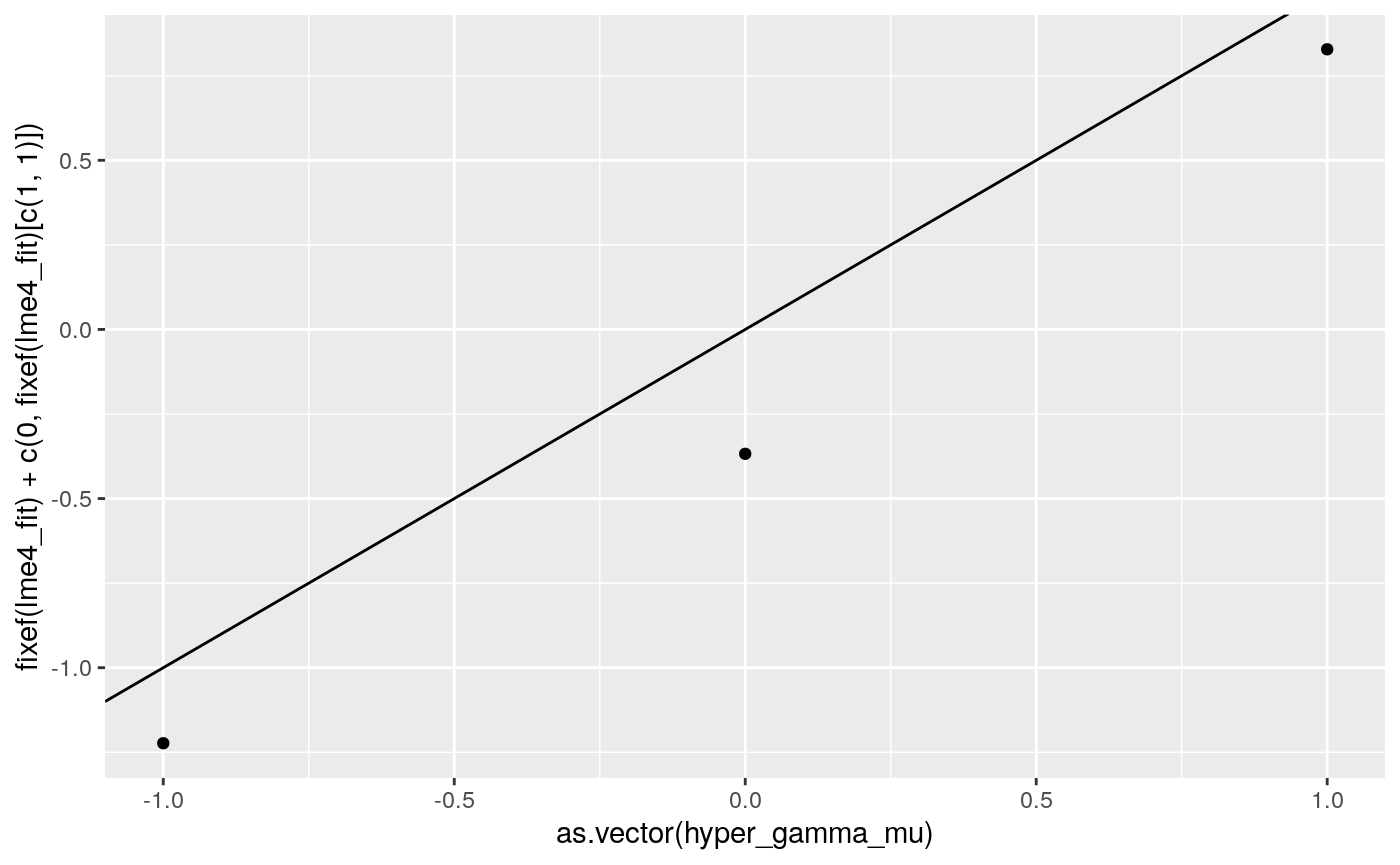
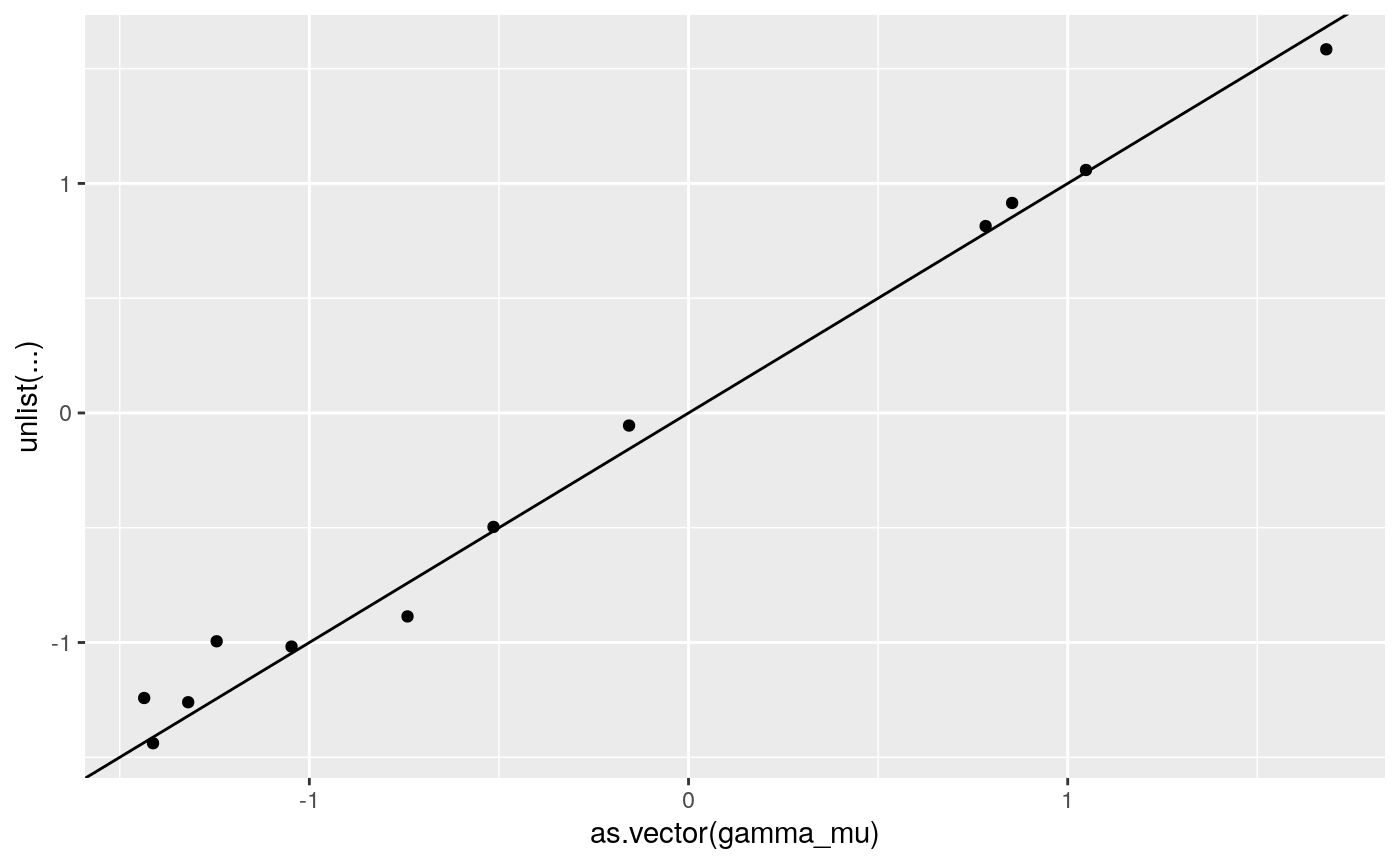
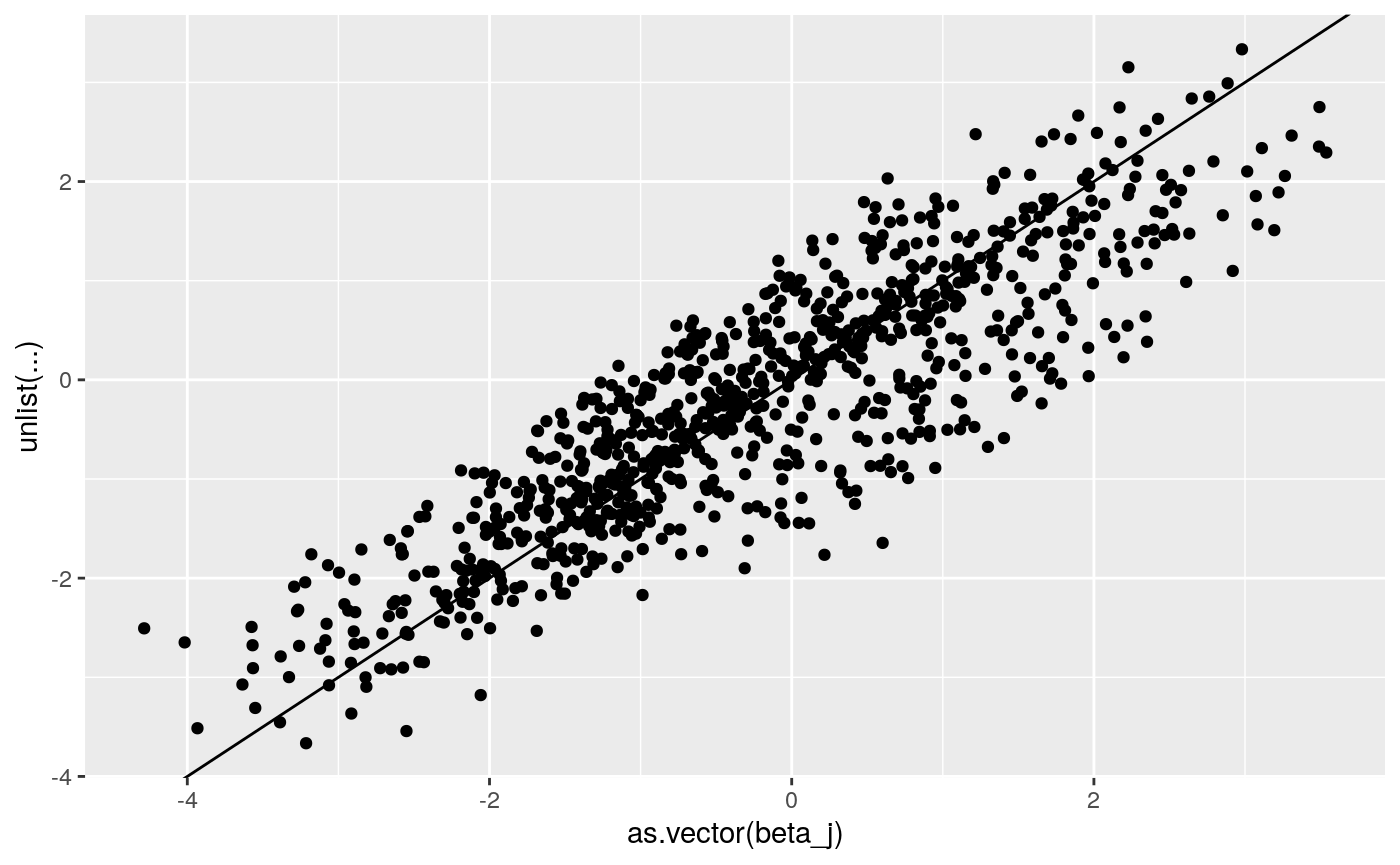
if(resolved(lme4_fit_2L_future)){
    lme4_fit_2L <- future::value(lme4_fit_2L_future)
    print(summary(lme4_fit_2L))
    rbind(
        means = unlist(dplyr::summarize(dplyr::group_by(dd, condition), mean = mean(y))[,2]),
        lme4_coef = c(fixef(lme4_fit_2L)[1], sum(fixef(lme4_fit_2L)[1:2]), sum(fixef(lme4_fit_2L)[c(1,3)])),
        lme4_p = arm::invlogit(c(fixef(lme4_fit_2L)[1], sum(fixef(lme4_fit_2L)[1:2]), sum(fixef(lme4_fit_2L)[c(1,3)]))))
    print(
        ggplot2::qplot(as.vector(beta_j),
                   unlist(coef(lme4_fit_2L)$`id`+
                              cbind(rep(0, dim(beta_j)[1]),coef(lme4_fit_2L)$id[,c(1,1)]))) +
        geom_abline(intercept = 0, slope = 1))
}
#> Loading...
#> Generalized linear mixed model fit by maximum likelihood (Laplace
#>   Approximation) [glmerMod]
#>  Family: binomial  ( logit )
#> Formula: y ~ 1 + condition + (1 + condition | id)
#>    Data: dd
#>
#>      AIC      BIC   logLik deviance df.resid
#>  96575.2  96659.9 -48278.6  96557.2    89991
#>
#> Scaled residuals:
#>     Min      1Q  Median      3Q     Max
#> -5.8025 -0.6205 -0.2837  0.6769  6.0092
#>
#> Random effects:
#>  Groups Name        Variance Std.Dev. Corr
#>  id     (Intercept) 1.332    1.154
#>         condition2  2.595    1.611    -0.58
#>         condition3  2.038    1.428    -0.61  0.20
#> Number of obs: 90000, groups:  id, 300
#>
#> Fixed effects:
#>             Estimate Std. Error z value Pr(>|z|)
#> (Intercept) -1.23053    0.06855 -17.951   <2e-16 ***
#> condition2   0.93459    0.09535   9.802   <2e-16 ***
#> condition3   2.02188    0.08524  23.721   <2e-16 ***
#> ---
#> Signif. codes:  0 '***' 0.001 '**' 0.01 '*' 0.05 '.' 0.1 ' ' 1
#>
#> Correlation of Fixed Effects:
#>            (Intr) cndtn2
#> condition2 -0.585
#> condition3 -0.615  0.225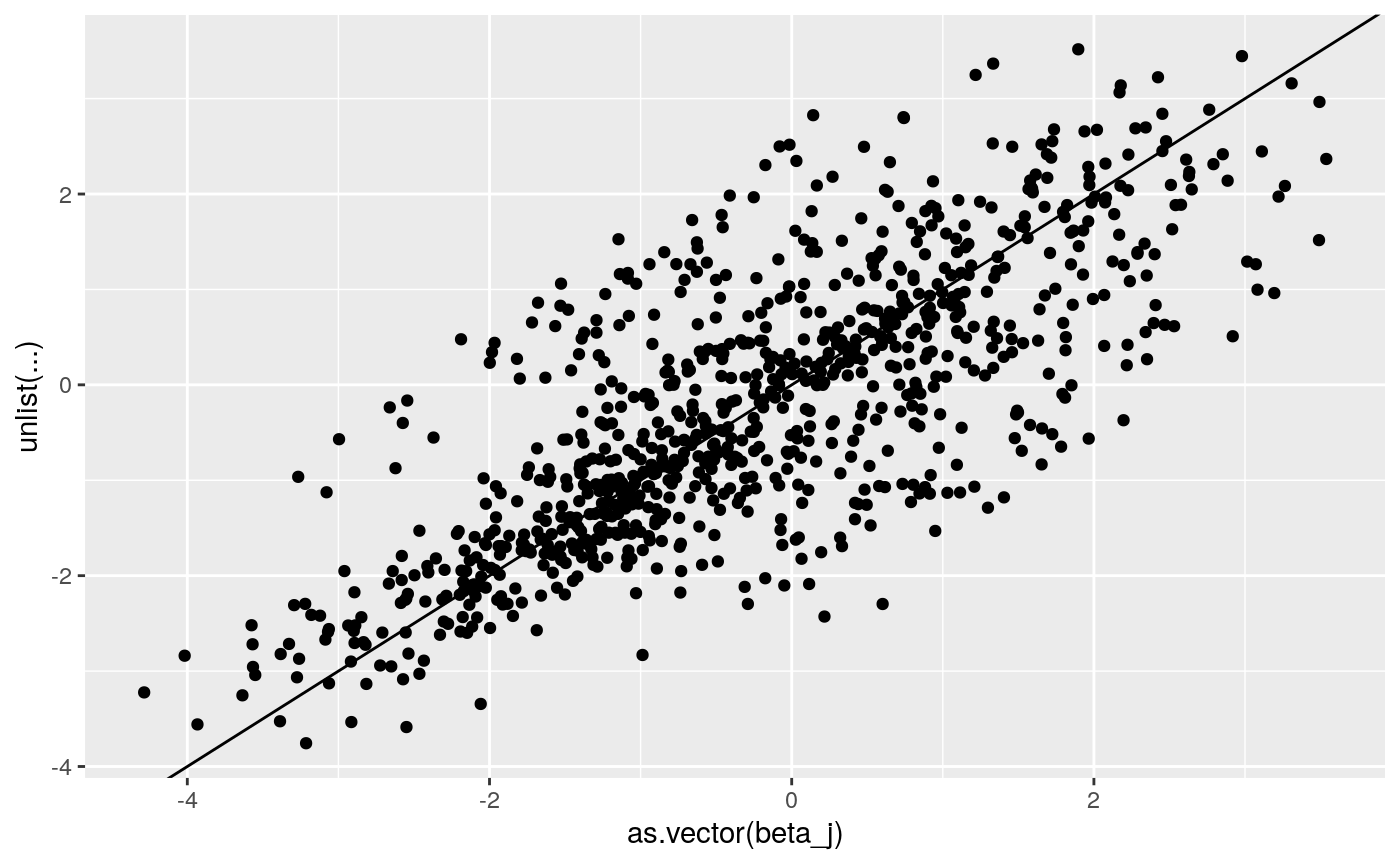
if(resolved(lme4_fit_2L_2rx_future)){
    lme4_fit_2L_2rx <- future::value(lme4_fit_2L_2rx_future)
    print(summary(lme4_fit_2L_2rx))
    rbind(
        means = unlist(dplyr::summarize(dplyr::group_by(dd, condition), mean = mean(y))[,2]),
        lme4_coef = c(fixef(lme4_fit_2L_2rx)[1], sum(fixef(lme4_fit_2L_2rx)[1:2]), sum(fixef(lme4_fit_2L_2rx)[c(1,3)])),
        lme4_p = arm::invlogit(c(fixef(lme4_fit_2L_2rx)[1], sum(fixef(lme4_fit_2L_2rx)[1:2]), sum(fixef(lme4_fit_2L_2rx)[c(1,3)]))))
    print(
        ggplot2::qplot(as.vector(beta_j),
                   unlist(coef(lme4_fit_2L_2rx)$`id`+
                              cbind(rep(0, dim(beta_j)[1]),coef(lme4_fit_2L_2rx)$id[,c(1,1)]))) +
        geom_abline(intercept = 0, slope = 1))
}
#> Loading...
#> Generalized linear mixed model fit by maximum likelihood (Laplace
#>   Approximation) [glmerMod]
#>  Family: binomial  ( logit )
#> Formula: y ~ 1 + condition + (1 + condition | id) + (1 + condition | grp)
#>    Data: dd
#>
#>      AIC      BIC   logLik deviance df.resid
#>  96318.7  96459.8 -48144.4  96288.7    89985
#>
#> Scaled residuals:
#>     Min      1Q  Median      3Q     Max
#> -5.5537 -0.6271 -0.2850  0.6748  5.9928
#>
#> Random effects:
#>  Groups Name        Variance Std.Dev. Corr
#>  id     (Intercept) 1.2781   1.1306
#>         condition2  1.7325   1.3163   -0.69
#>         condition3  1.5496   1.2448   -0.66  0.56
#>  grp    (Intercept) 0.0547   0.2339
#>         condition2  0.7732   0.8793   -0.19
#>         condition3  0.4639   0.6811   -0.49 -0.65
#> Number of obs: 90000, groups:  id, 300; grp, 4
#>
#> Fixed effects:
#>             Estimate Std. Error z value Pr(>|z|)
#> (Intercept)  -1.2233     0.1319  -9.274  < 2e-16 ***
#> condition2    0.8556     0.3979   2.150   0.0315 *
#> condition3    2.0514     0.3217   6.377 1.81e-10 ***
#> ---
#> Signif. codes:  0 '***' 0.001 '**' 0.01 '*' 0.05 '.' 0.1 ' ' 1
#>
#> Correlation of Fixed Effects:
#>            (Intr) cndtn2
#> condition2 -0.230
#> condition3 -0.515 -0.547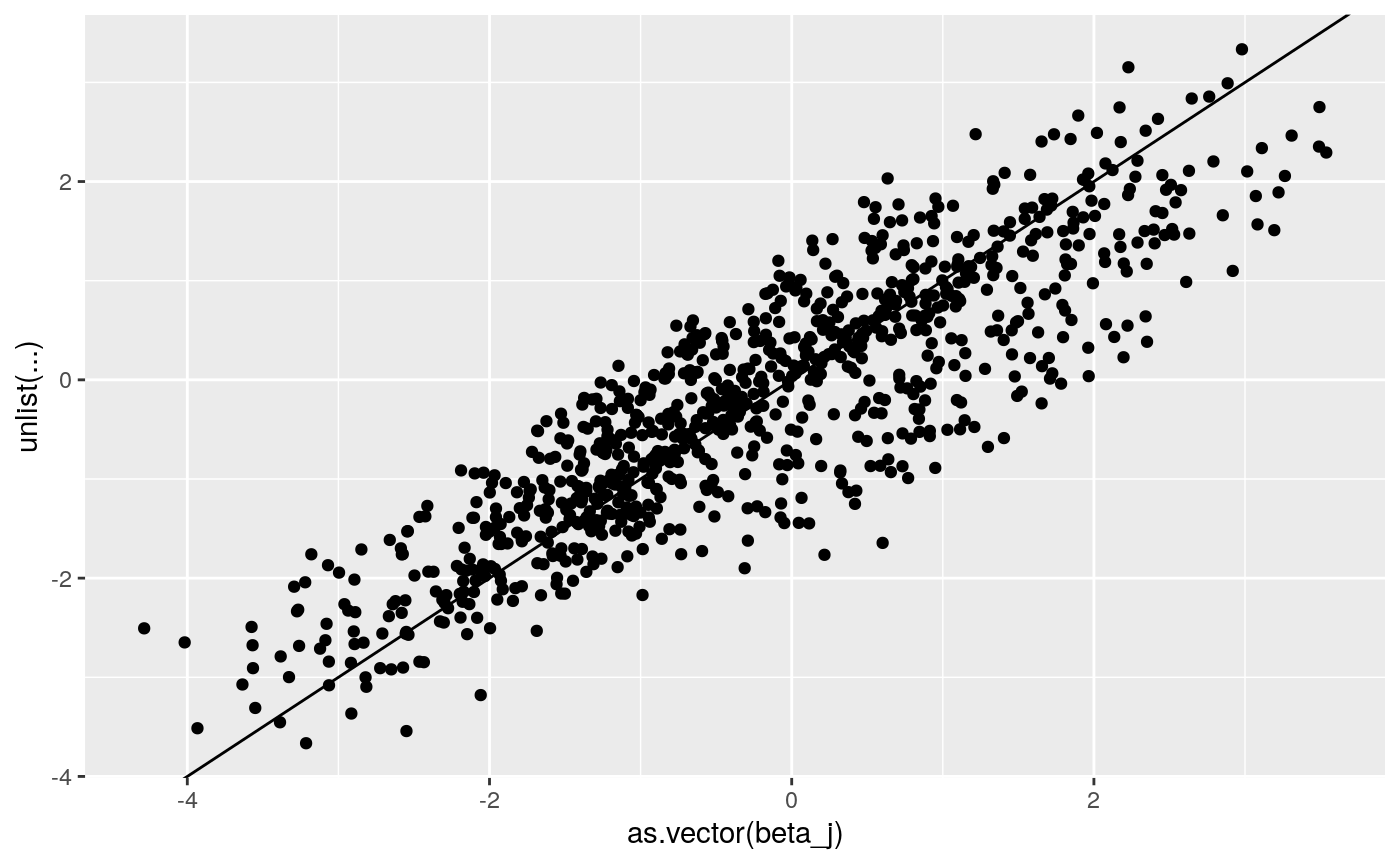
The Stan model that is being estimated is:
\[ \text{press_right}_{i} \sim \text{bernoulli_logit}(x_{i}\beta_{jj[i]}) \\ \beta_{j} \sim \mathcal{N}_{\text{mv}}(\delta_{mm[j]}, \Sigma_{\beta}) \\ \Sigma = \text{diag_matrix}(\tau) \Omega \text{diag_matrix}(\tau) \\ \tau_{k} \sim \text{Cauchy}(0, 2.5) \\ \Omega \sim \text{lkj_corr}(2)\\ \delta_{mk} \sim \mathcal{N} (\mu_{\delta k}, \sigma_{\delta}) \\ \mu_{\delta} \sim \mathcal{N} (0, 5) \\ \sigma_{\delta} \sim \text{exponential} (1) \]
Where
- press_right is a binary indicator that the participant pressed the key on the right,
- \(x_{i}\) is dummy coded for each trial’s condition,
- \(\beta_j\) is a vector of subject-level (for subject \(jj[i]\)) coefficients for all K conditions,
- \(\delta_m\) is a vector of K means (again, per condition) for participant \(j\)’s group \(mm[j]\),
- \(\Sigma_{\beta}\) is the covariance matrix, optimized as recommended in the Stan manual via \(\tau\) and \(\Omega\),
- \(\mu_{\delta}\) is the population mean for each K condition,
- and \(\sigma_{\delta}\) is the scale parameter for the population means.
# data {
  # int<lower=1> N; //number of subjects
  # int<lower=1> T; //max number of trials
  # int<lower=2> K; //number of trial predictors (in this case, conditions)
  # int<lower=1> L; //number of subject-level predictors. 1 = intercept only
  # int<lower=1,upper=T> Tsubj[N]; //trials per subject
  # int<lower=-1,upper=1> press_right[N,T]; //choices "0" = left, "1" = right
  # int<lower=-1,upper=3> condition[N,T]; //1 = ctrl, 2 = mateseeking, 3 = status
  # matrix[N, L] u; //group predictors. u[,1] = 1 for intercept
# }
press_right_mat <- matrix(dd$y, nrow = j)
condition_mat <- matrix(as.numeric(dd$condition), nrow = j)
data_for_stan <- list(
    N = j,
    T = t*c,
    K = c,
    M = g,
    mm = gg,
    Tsubj = rep(t*3, j),
    press_right = press_right_mat,
    condition = condition_mat
)

stan_fit_fn.orig <- '/data/jflournoy/split/probly/stan_test_fit_c_l3.RDS'
stan_fit_fn.repar <- '/data/jflournoy/split/probly/stan_test_fit_non_c_l3.RDS'
if(!file.exists(stan_fit_fn.orig)){
    plan(multiprocess)
    stan_m_c <- rstan::stan_model(file = '../exec/splt_rl_mvnorm_test_c_l3.stan')
    stan_optim_c <- rstan::optimizing(stan_m_c,
                                    data = data_for_stan)
    round(stan_optim_c$par[grep('delta', names(stan_optim_c$par))],3)
    stan_fit_test_c_f <- future({rstan::stan(file = '../exec/splt_rl_mvnorm_test_c_l3.stan',
                                             data = data_for_stan, chains = 4, iter = 1500,
                                             warmup = 1000, cores = 4, open_progress = T)})
    stan_fit_test_c <- value(stan_fit_test_c_f)
    saveRDS(stan_fit_test_c, stan_fit_fn.orig)
} else {
    stan_fit_test_c <- readRDS(stan_fit_fn.orig)
}
if(!file.exists(stan_fit_fn.repar)){
    plan(multiprocess)
    stan_m_nc <- rstan::stan_model(file = '../exec/splt_rl_mvnorm_test_non_c_l3.stan')
    stan_optim_nc <- rstan::optimizing(stan_m_nc,
                                    data = data_for_stan)
    round(stan_optim_nc$par[grep('delta', names(stan_optim_nc$par))],3)
    stan_fit_test_nc_f <- future({rstan::stan(file = '../exec/splt_rl_mvnorm_test_non_c_l3.stan',
                                              data = data_for_stan, chains = 4, iter = 1500,
                                              warmup = 1000, cores = 4, open_progress = T)})
    stan_fit_test_nc <- value(stan_fit_test_nc_f)
    saveRDS(stan_fit_test_nc, stan_fit_fn.repar)
} else {
    stan_fit_test_nc <- readRDS(stan_fit_fn.repar)
}

par_names.c <- grep('(delta|beta)', names(stan_fit_test_c), value = T)
par_names.nc <- grep('(delta|beta)', names(stan_fit_test_nc), value = T)
stan_fit_extract.c <- rstan::extract(stan_fit_test_c, pars = par_names.c)
stan_fit_extract.nc <- rstan::extract(stan_fit_test_nc, pars = par_names.nc)
bayesplot::mcmc_dens(as.array(stan_fit_test_c), regex_pars = 'mu_delta\\[\\d\\]')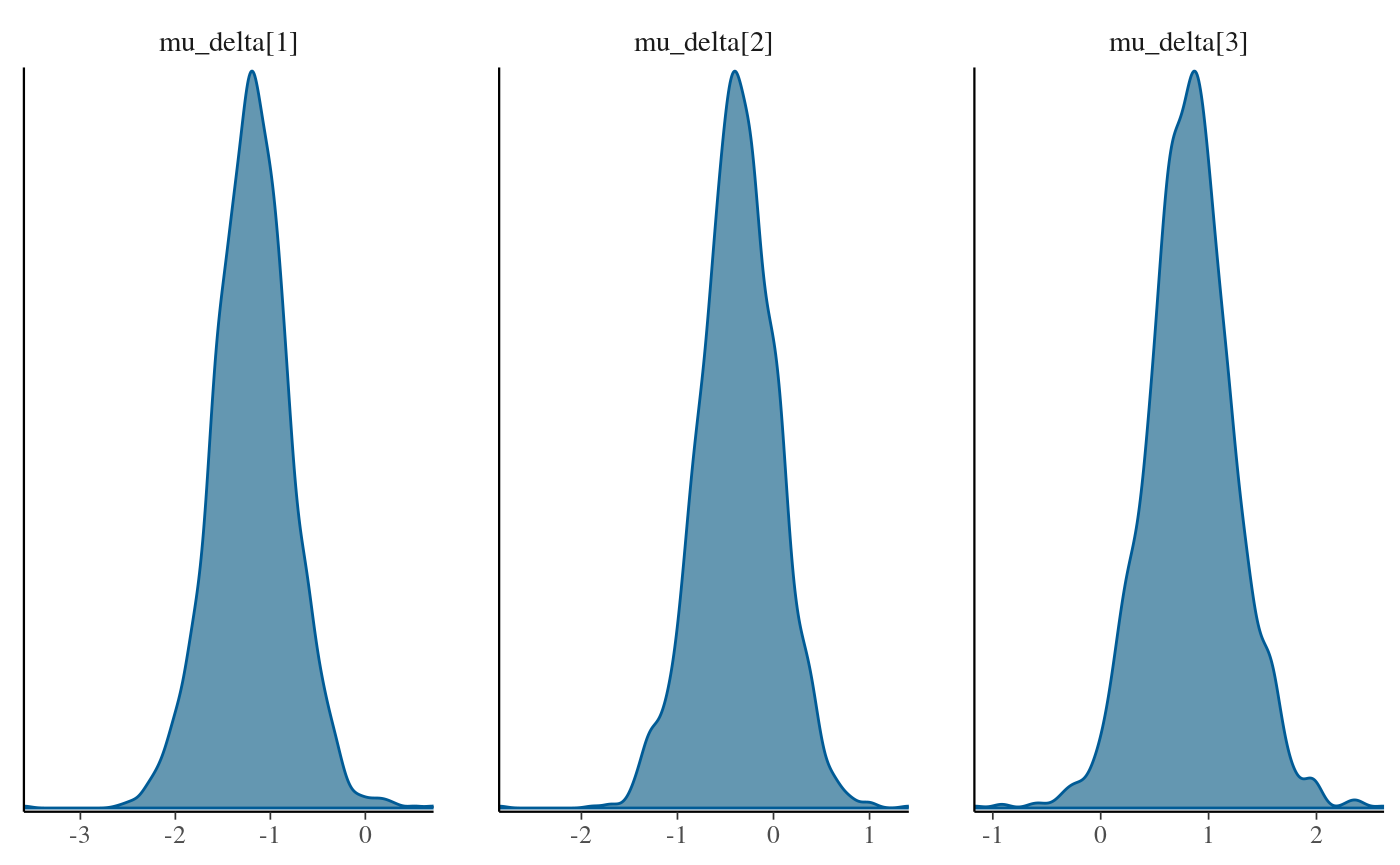
stan_fit_c_means <- lapply(stan_fit_extract.c, mean)
stan_fit_nc_means <- lapply(stan_fit_extract.nc, mean)
print(
    ggplot2::qplot(as.vector(beta_j),
                   as.numeric(
                       stan_fit_c_means[grep('beta\\[', names(stan_fit_c_means))])) +
        geom_abline(intercept = 0, slope = 1))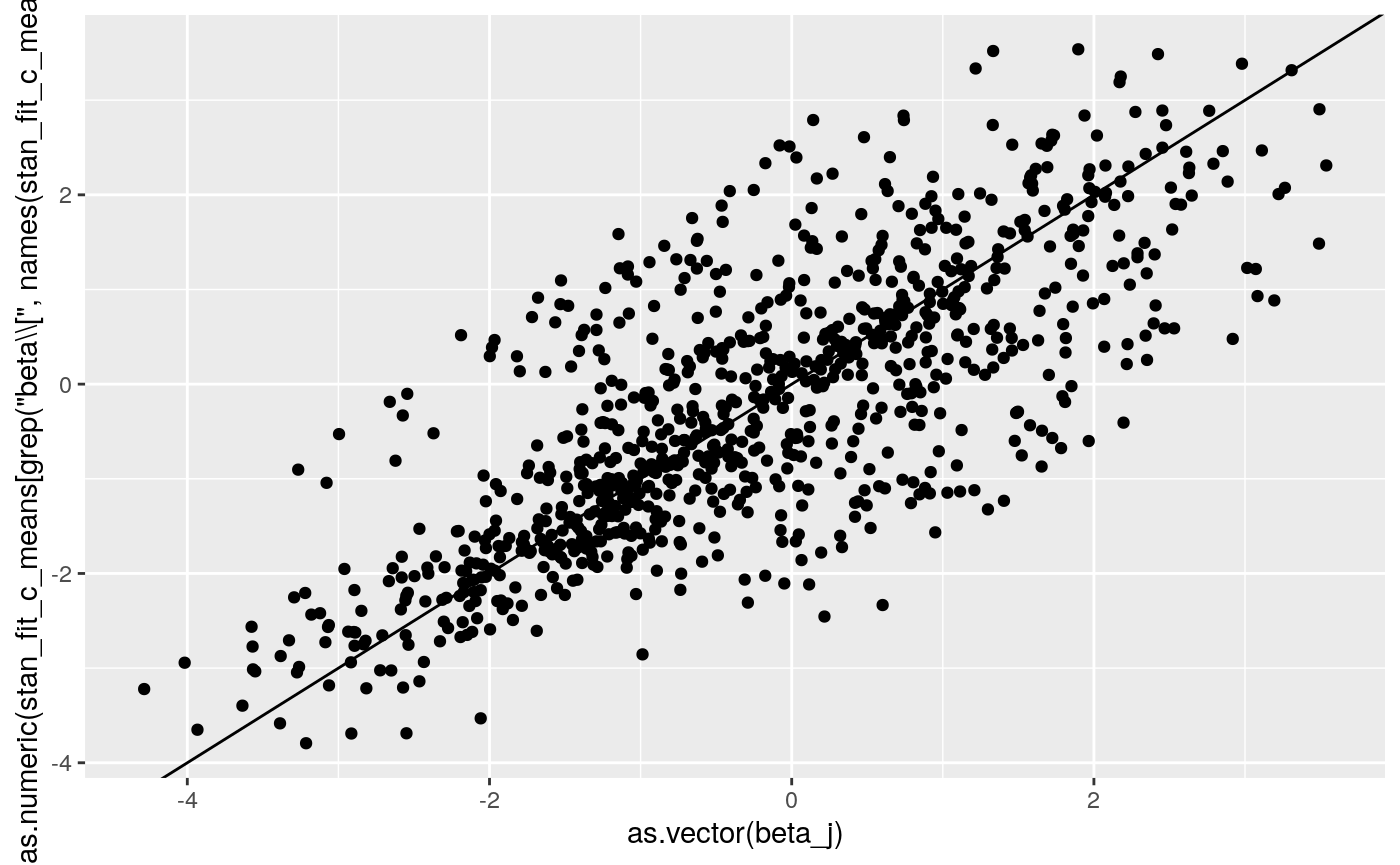
print(
    ggplot2::qplot(as.vector(beta_j),
                   as.numeric(
                       stan_fit_nc_means[grep('beta\\[', names(stan_fit_nc_means))])) +
        geom_abline(intercept = 0, slope = 1))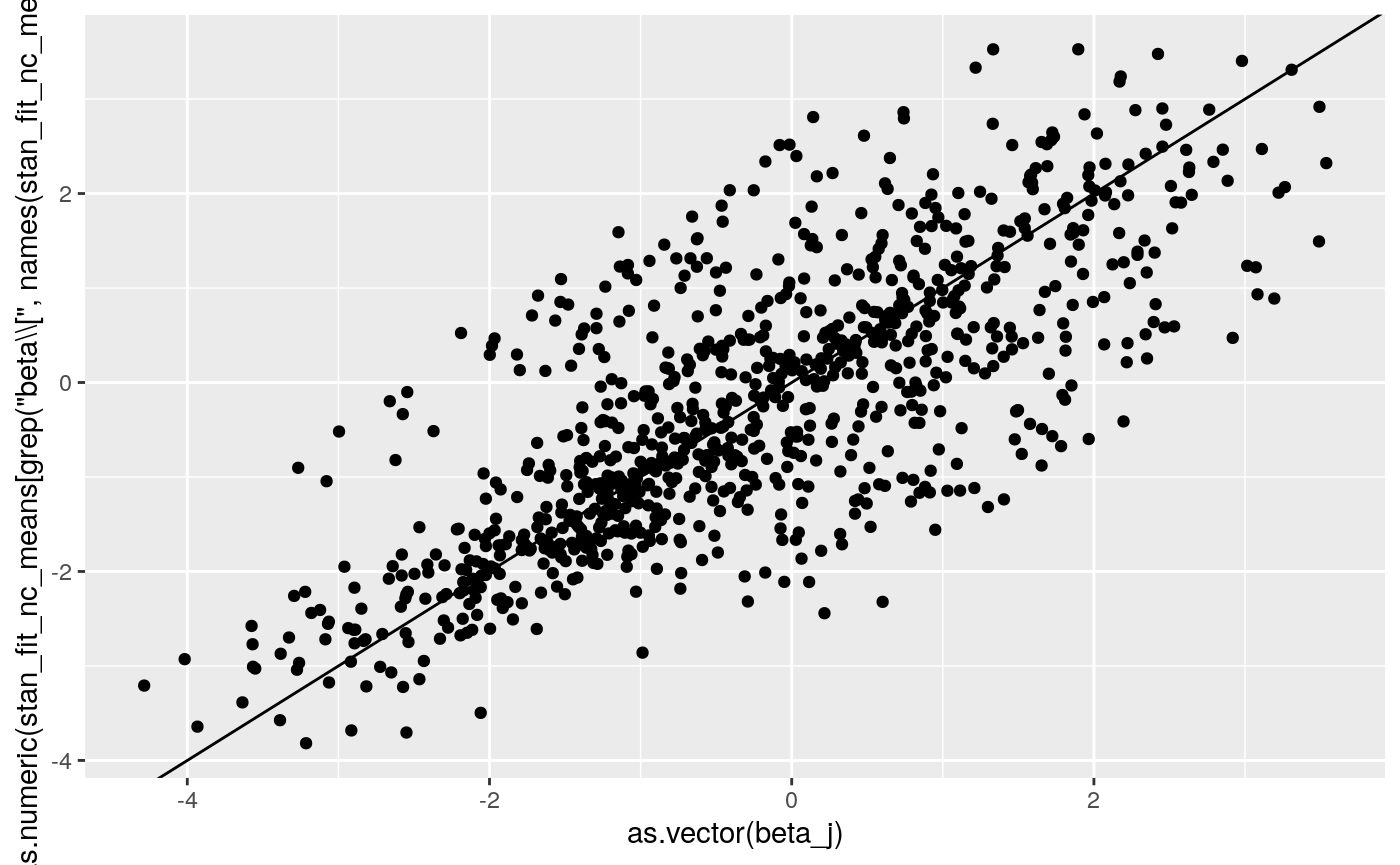
print(
    ggplot2::qplot(as.vector(gamma_mu),
                   as.numeric(
                       stan_fit_c_means[grep('delta\\[\\d,', names(stan_fit_c_means))])) +
        geom_abline(intercept = 0, slope = 1))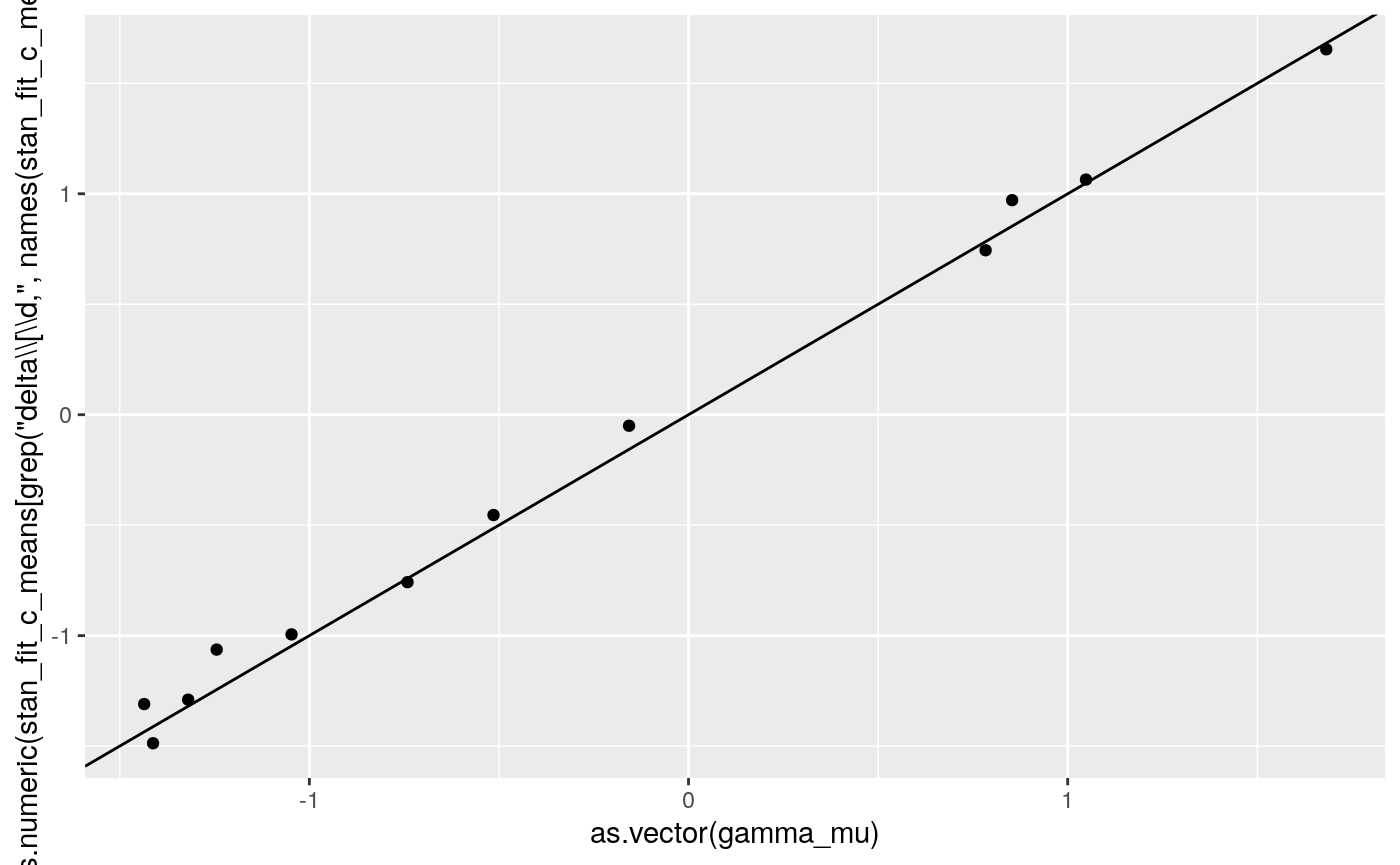
print(
    ggplot2::qplot(as.vector(gamma_mu),
                   as.numeric(
                       stan_fit_nc_means[grep('delta\\[\\d,', names(stan_fit_nc_means))])) +
        geom_abline(intercept = 0, slope = 1))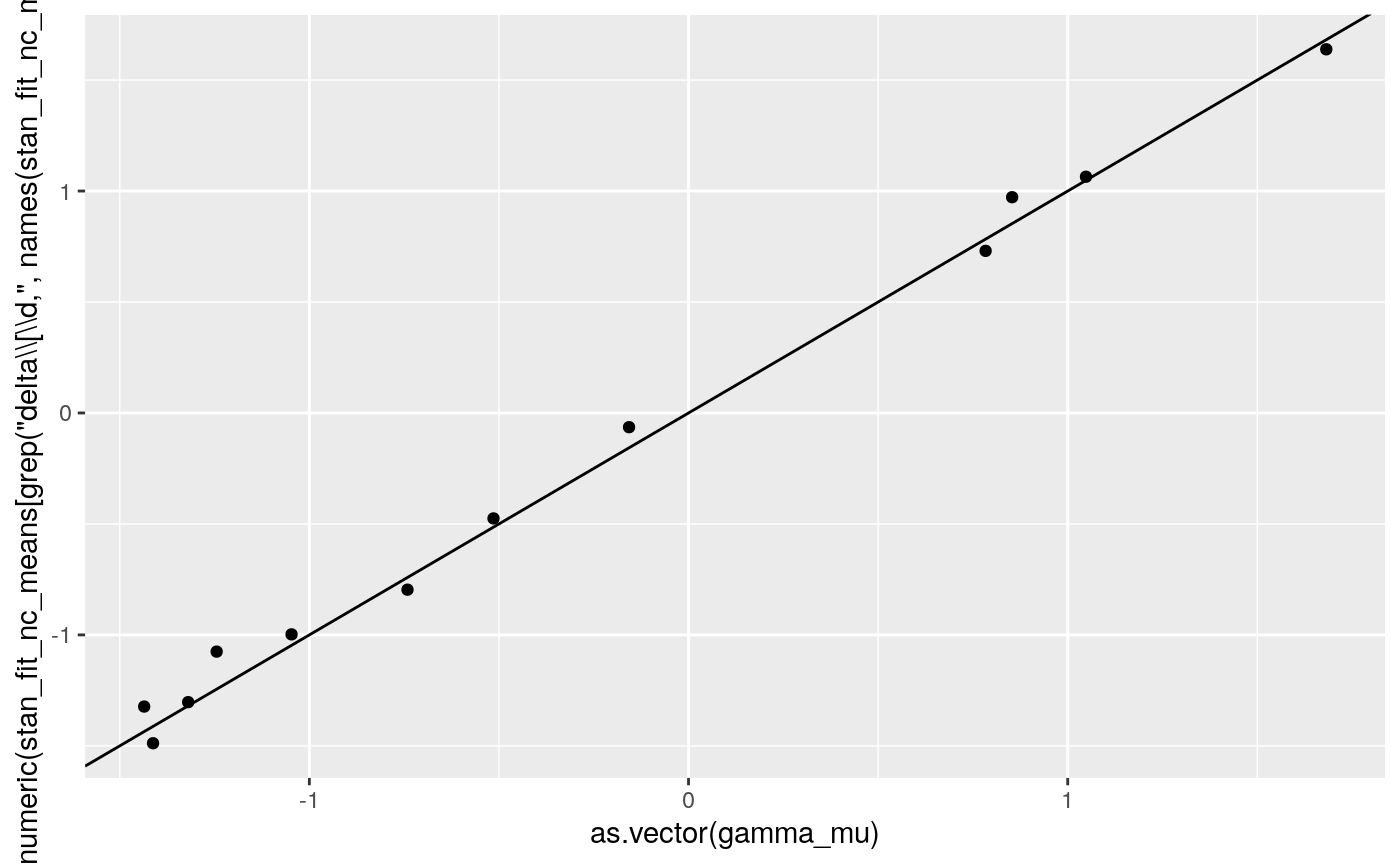
rbind(stan = stan_fit_c_means[grep('mu_delta', names(stan_fit_c_means))],
      raw_p = arm::logit(unlist(dplyr::summarize(dplyr::group_by(dd, condition), mean = mean(y))[,2])),
      group_p = apply(gamma_mu, 2, mean))
#>         mu_delta[1] mu_delta[2] mu_delta[3]
#> stan    -1.190436   -0.3686154  0.836373
#> raw_p   -0.9823117  -0.2945104  0.6583961
#> group_p -1.227143   -0.4394004  0.7905008
rbind(stan = stan_fit_nc_means[grep('mu_delta', names(stan_fit_nc_means))],
      raw_p = arm::logit(unlist(dplyr::summarize(dplyr::group_by(dd, condition), mean = mean(y))[,2])),
      group_p = apply(gamma_mu, 2, mean))
#>         mu_delta[1] mu_delta[2] mu_delta[3]
#> stan    -1.162693   -0.3534274  0.8202649
#> raw_p   -0.9823117  -0.2945104  0.6583961
#> group_p -1.227143   -0.4394004  0.7905008
stan_fit_c_means$sigma_delta
#> [1] 0.8038438
stan_fit_nc_means$sigma_delta
#> [1] 0.8042396

summary(stan_fit_test_c, pars = grep('delta',par_names.c, value = T), probs = c(.025, .5, .975))$summary
#>                    mean     se_mean        sd        2.5%         50%
#> mu_delta[1] -1.19043600 0.009609850 0.4103494 -2.00752410 -1.19217483
#> mu_delta[2] -0.36861538 0.008711023 0.4082720 -1.22505029 -0.37287830
#> mu_delta[3]  0.83637300 0.010086945 0.4155883  0.05159399  0.83590059
#> sigma_delta  0.80384382 0.006012827 0.2108235  0.50265092  0.76334216
#> delta[1,1]  -1.29003323 0.012168451 0.1278729 -1.53910172 -1.28924739
#> delta[2,1]  -1.30984239 0.009878876 0.1351301 -1.57096298 -1.30849534
#> delta[3,1]  -0.75797525 0.009174405 0.1317907 -1.01197304 -0.76139865
#> delta[4,1]  -1.48716536 0.009676619 0.1325258 -1.75646132 -1.48719736
#> delta[1,2]   1.06425176 0.006803405 0.1075503  0.83998079  1.06821022
#> delta[2,2]  -1.06330302 0.007809675 0.1228586 -1.30564928 -1.06457622
#> delta[3,2]  -0.45419537 0.011068580 0.1257497 -0.69478455 -0.45126109
#> delta[4,2]  -0.99447886 0.007971945 0.1184132 -1.22552953 -0.99331691
#> delta[1,3]  -0.05010475 0.007035527 0.1071256 -0.25501624 -0.05146253
#> delta[2,3]   0.74431965 0.008070989 0.1245280  0.49444595  0.73854894
#> delta[3,3]   0.97109405 0.007389104 0.1112167  0.76175588  0.97077260
#> delta[4,3]   1.65394947 0.006730866 0.1199622  1.41998688  1.65581808
#>                  97.5%     n_eff     Rhat
#> mu_delta[1] -0.3707453 1823.3686 1.002813
#> mu_delta[2]  0.4145897 2196.6501 1.001045
#> mu_delta[3]  1.6557548 1697.4906 1.001098
#> sigma_delta  1.3184927 1229.3644 1.001660
#> delta[1,1]  -1.0391111  110.4299 1.026023
#> delta[2,1]  -1.0501067  187.1065 1.001170
#> delta[3,1]  -0.5020760  206.3543 1.011909
#> delta[4,1]  -1.2296722  187.5659 1.017266
#> delta[1,2]   1.2622266  249.9024 1.011011
#> delta[2,2]  -0.8260618  247.4830 1.017098
#> delta[3,2]  -0.2081034  129.0715 1.025577
#> delta[4,2]  -0.7579529  220.6336 1.010884
#> delta[1,3]   0.1526026  231.8426 1.004511
#> delta[2,3]   1.0027901  238.0568 1.007483
#> delta[3,3]   1.1987591  226.5460 1.021901
#> delta[4,3]   1.8836240  317.6486 1.014358
summary(stan_fit_test_nc, pars = grep('delta',par_names.nc, value = T), probs = c(.025, .5, .975))$summary
#>                       mean     se_mean        sd         2.5%         50%
#> mu_delta[1]    -1.16269273 0.018560900 0.3909543 -1.921430020 -1.17291204
#> mu_delta[2]    -0.35342743 0.021569488 0.4220587 -1.222371292 -0.33908163
#> mu_delta[3]     0.82026485 0.021207903 0.4154852  0.002475087  0.81519036
#> sigma_delta     0.80423959 0.009427298 0.2146855  0.500985535  0.76222704
#> delta_raw[1,1] -0.17332066 0.024226906 0.4962157 -1.141615488 -0.17300542
#> delta_raw[2,1] -0.19806005 0.023926037 0.5066053 -1.184894863 -0.20365825
#> delta_raw[3,1]  0.49234107 0.026845765 0.5292283 -0.539726178  0.48836849
#> delta_raw[4,1] -0.41767603 0.025843685 0.5074712 -1.426668662 -0.40875410
#> delta_raw[1,2]  1.87344300 0.029607839 0.6916709  0.545735634  1.86109362
#> delta_raw[2,2] -0.95714628 0.031046640 0.5810495 -2.087261079 -0.96042475
#> delta_raw[3,2] -0.16442341 0.027827607 0.5248824 -1.196405113 -0.16884929
#> delta_raw[4,2] -0.85334894 0.029999748 0.5598560 -1.942417786 -0.86572549
#> delta_raw[1,3] -1.16635987 0.028956949 0.5772055 -2.309412605 -1.16572935
#> delta_raw[2,3] -0.11593031 0.027200285 0.5133032 -1.144703974 -0.11131769
#> delta_raw[3,3]  0.19972561 0.029670061 0.5248678 -0.789251108  0.19482733
#> delta_raw[4,3]  1.08297439 0.026842785 0.5721005 -0.008156408  1.08077888
#> delta[1,1]     -1.30302100 0.011533961 0.1300011 -1.570785860 -1.30270619
#> delta[2,1]     -1.32292556 0.011156980 0.1419978 -1.596785537 -1.31461835
#> delta[3,1]     -0.79626986 0.017805602 0.1494726 -1.120883814 -0.78769049
#> delta[4,1]     -1.48819065 0.012059765 0.1272798 -1.726155344 -1.48449288
#> delta[1,2]      1.06436500 0.010597719 0.1156182  0.836098520  1.06652706
#> delta[2,2]     -1.07531380 0.010889620 0.1285082 -1.336286921 -1.07514393
#> delta[3,2]     -0.47523626 0.010234222 0.1207604 -0.708037366 -0.47760273
#> delta[4,2]     -0.99765519 0.010351628 0.1171438 -1.225488118 -0.99821446
#> delta[1,3]     -0.06408593 0.008503437 0.1085670 -0.280036197 -0.06438867
#> delta[2,3]      0.73036346 0.008036718 0.1183135  0.504117751  0.72644345
#> delta[3,3]      0.97218021 0.011398995 0.1240980  0.737036405  0.97051666
#> delta[4,3]      1.63862731 0.007815076 0.1183751  1.421051838  1.63574630
#>                      97.5%     n_eff      Rhat
#> mu_delta[1]    -0.36455101 443.66370 1.0022321
#> mu_delta[2]     0.50292445 382.88305 1.0076629
#> mu_delta[3]     1.68946098 383.80940 0.9992077
#> sigma_delta     1.32556907 518.59811 1.0094901
#> delta_raw[1,1]  0.81585166 419.51273 1.0008227
#> delta_raw[2,1]  0.80898873 448.33007 1.0014697
#> delta_raw[3,1]  1.56650393 388.62847 1.0039714
#> delta_raw[4,1]  0.57659683 385.57954 1.0088500
#> delta_raw[1,2]  3.28230814 545.73979 1.0048237
#> delta_raw[2,2]  0.18990517 350.26530 1.0138111
#> delta_raw[3,2]  0.86858851 355.77246 1.0093772
#> delta_raw[4,2]  0.25850845 348.27118 1.0084607
#> delta_raw[1,3] -0.03491447 397.33359 0.9999503
#> delta_raw[2,3]  0.85658033 356.12381 1.0002144
#> delta_raw[3,3]  1.21080203 312.94137 1.0039193
#> delta_raw[4,3]  2.21068176 454.24435 1.0014899
#> delta[1,1]     -1.04495529 127.03905 1.0353946
#> delta[2,1]     -1.04768055 161.98321 1.0225393
#> delta[3,1]     -0.51450487  70.47092 1.0344928
#> delta[4,1]     -1.24166774 111.38869 1.0692491
#> delta[1,2]      1.28610298 119.02210 1.0263070
#> delta[2,2]     -0.83775743 139.26309 1.0456529
#> delta[3,2]     -0.24210940 139.23218 1.0199574
#> delta[4,2]     -0.76762090 128.06237 1.0523552
#> delta[1,3]      0.14670704 163.00713 1.0255314
#> delta[2,3]      0.97308325 216.72600 1.0072571
#> delta[3,3]      1.20641255 118.52133 1.0371555
#> delta[4,3]      1.87519548 229.43210 1.0267197